Stereoscopes
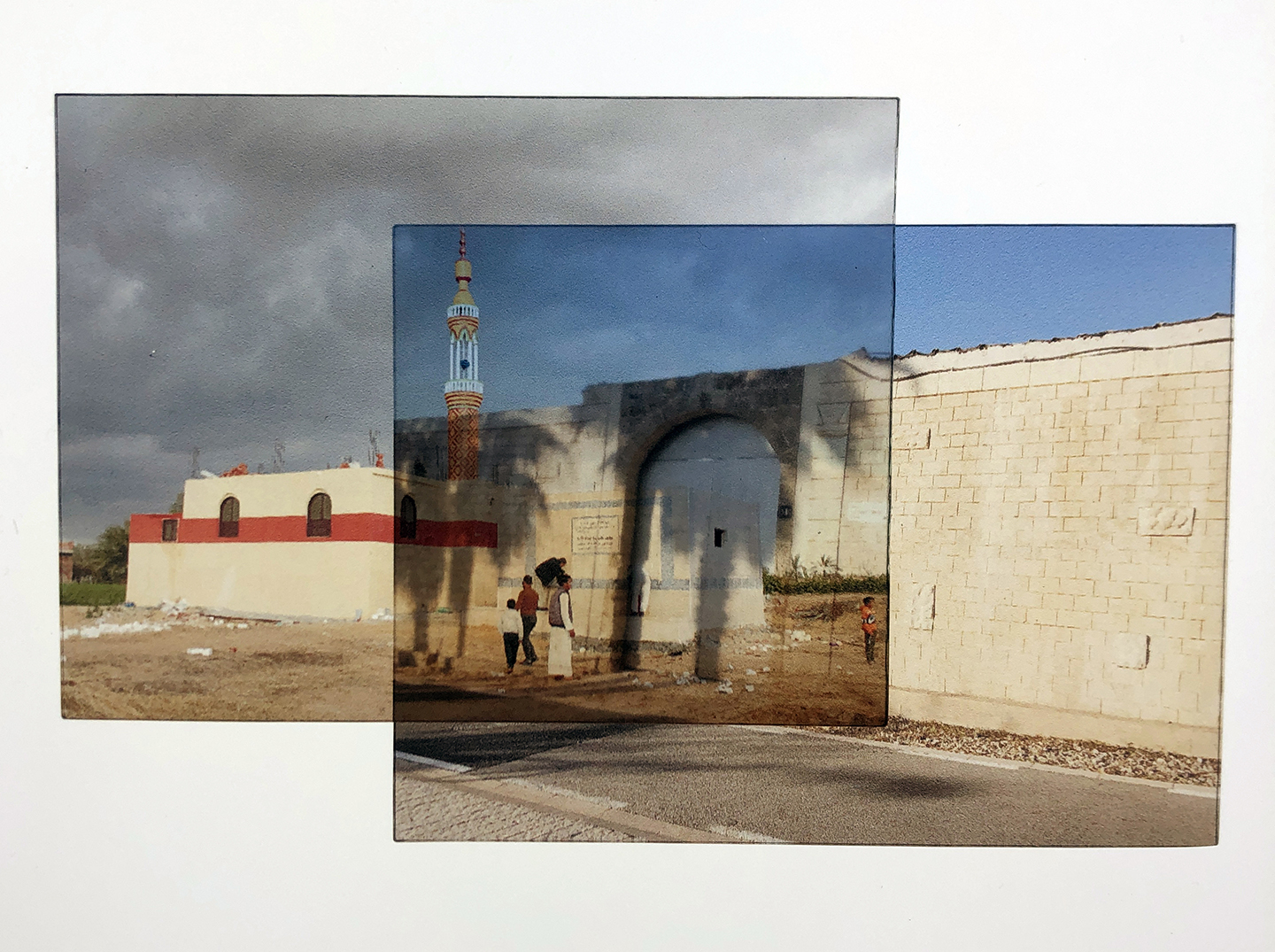
A series of digital inkjet prints on glass, 2020-2021
While exploring the Abu Kabir neighborhood and its place names, I discovered a small village south of the Suez Canal in Egypt’s Somalia region, which gave Abu Kabir in Israel its name. Historical records show that migrants, particularly soldiers of Ibrahim Pasha, arrived in Palestine in 1832 and named the neighborhood after their original village, Tel Abu Kabir.
Using Google Maps, I collected user-uploaded images of the area, most likely taken with mobile phones to document objects, places, or moments. For me, these images lacked narrative, political, or national meaning. Their quality reminded me of Robert Walser’s Microscripts and his focus on everyday details.
This project is a photographic collage that combines images I collected online with photographs I took while walking in the neighborhood between summer and fall 2020. Each image was printed on glass measuring 2 3/4 x 4 in (7 × 10 cm), a format and medium common in the nineteenth century. Juxtaposing images from both locations reflects the stereoscope’s function of uniting two separate images into one. Like wandering, this process shifts between perspectives that coexist without fully merging. The resulting slides form a temporary and ephemeral union.
The stereoscope uses two lenses, allowing each eye to view a different image, which the brain then unifies to create depth. This process parallels wandering as a way of seeing, moving between physical and digital spaces, and between the present and a past that is no longer visible.
Juxtaposing images from the two places reflects the stereoscope’s operation, uniting separate images into a single image. Like wandering, this process moves between viewpoints that coexist without fully merging. Inspired by this approach, the work offers a layered reading of place, echoing its past and revealing one layer among many.